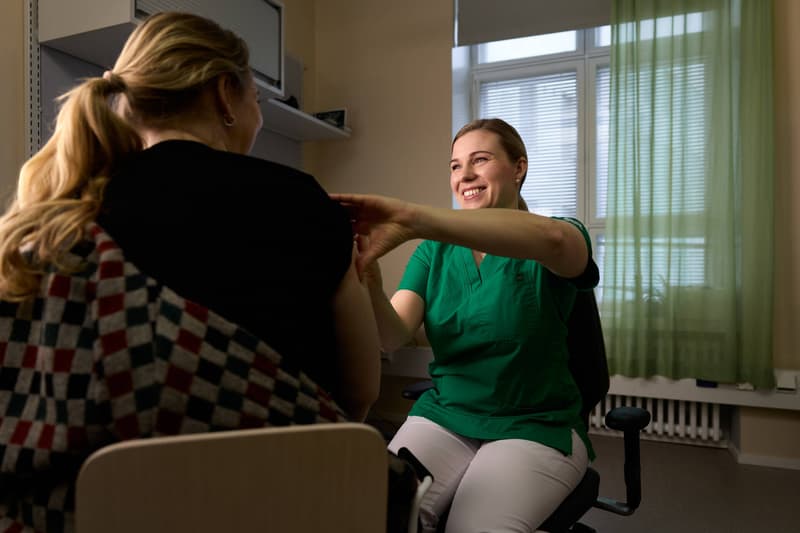
Traveller's vaccinations
Read more
Published 3/6/2025
Some vaccinations are part of the national vaccination program and are so-called basic vaccinations, while others are seasonal vaccinations, such as the influenza vaccine. If you are going on a trip, check the validity of your vaccinations well in advance. Learn more about traveler's vaccinations and acquire the necessary additional vaccinations according to your destination.
Possible time-bound promotional prices may differ from these.
| Service | Price | Info |
|---|---|---|
| Hepatitis A (adult) | 120,20 € No Kela reimbursement Price 120,20 € No Kela reimbursement | |
| Hepatitis A (under 16 years old) Information about the traveler's vaccinations. | 95,00 € No Kela reimbursement Price 95,00 € No Kela reimbursement | Information about the traveler's vaccinations. |
| Hepatitis A+B vaccine (adult) | Mobile Benefit 122,00 € 132,40 € No Kela reimbursement Mobile Benefit 122,00 € Price 132,40 € No Kela reimbursement | |
| Hepatitis A+B vaccine (under 16 years old) | Mobile Benefit 96,00 € 111,30 € No Kela reimbursement Mobile Benefit 96,00 € Price 111,30 € No Kela reimbursement | |
| Tetanus and diphtheria vaccine Information about the tetanus-diphtheria vaccine. Book an appointment for vaccination | 63,80 € No Kela reimbursement Price 63,80 € No Kela reimbursement | Information about the tetanus-diphtheria vaccine. Book an appointment for vaccination |
| Tetanus-diphtheria-pertussis (dtap) vaccine Information about the tetanus-diphtheria-pertussis vaccine. | 81,70 € No Kela reimbursement Price 81,70 € No Kela reimbursement | Information about the tetanus-diphtheria-pertussis vaccine. |
| Influenza vaccine Booking opens in week 39. Learn more about influenza vaccine | Mobile Benefit 55,00 € 58,00 € Kela reimbursement deducted from the price Mobile Benefit 55,00 € Price 58,00 € Kela reimbursement deducted from the price | Booking opens in week 39. Learn more about influenza vaccine |
| Nasal spray influenza vaccination (for children aged 2–17) Booking opens in October–November 2026. Learn more about nasal spray influenza vaccination | 73,30 € Kela reimbursement deducted from the price Price 73,30 € Kela reimbursement deducted from the price | Booking opens in October–November 2026. Learn more about nasal spray influenza vaccination |
| High-dose influenza vaccine for people aged over 60 Booking opens in week 39. Learn more about high-dose influenza vaccine | Mobile Benefit 95,00 € 98,50 € Kela reimbursement deducted from the price Mobile Benefit 95,00 € Price 98,50 € Kela reimbursement deducted from the price | Booking opens in week 39. Learn more about high-dose influenza vaccine |
| COVID-19 vaccine | 145,90 € Kela reimbursement deducted from the price Price 145,90 € Kela reimbursement deducted from the price | |
| Pneumococcal vaccine The price of the pneumococcal vaccination, depending on the vaccine, is 144.30–169.50 €. More information about the pneumococcal vaccine. Book an appointment for pneumococcal vaccination | from 142,30 € No Kela reimbursement Price from 142,30 € No Kela reimbursement | The price of the pneumococcal vaccination, depending on the vaccine, is 144.30–169.50 €. More information about the pneumococcal vaccine. Book an appointment for pneumococcal vaccination |
| Tick-borne encephalitis vaccine (adults) Price per vaccination. More information about the tick-borne encephalitis vaccine. Book an appointment for tick-borne encephalitis vaccination | Mobile Benefit 66,00 € 80,00 € No Kela reimbursement Mobile Benefit 66,00 € Price 80,00 € No Kela reimbursement | Price per vaccination. More information about the tick-borne encephalitis vaccine. Book an appointment for tick-borne encephalitis vaccination |
| Tick-borne encephalitis vaccine (children) Price per vaccination. More information about the tick-borne encephalitis vaccine. Book an appointment for tick-borne encephalitis vaccination | Mobile Benefit 66,00 € 77,20 € No Kela reimbursement Mobile Benefit 66,00 € Price 77,20 € No Kela reimbursement | Price per vaccination. More information about the tick-borne encephalitis vaccine. Book an appointment for tick-borne encephalitis vaccination |
In most of our locations, children and adults can be vaccinated without an appointment. You can confirm the situation by calling our customer service number and, if necessary, book an appointment. You can also book an appointment for the most common vaccinations through our online booking system. Vaccinations are administered by Mehiläinen's nurses, health nurses, and doctors.
Vaccination can effectively and safely prevent diseases such as pox and infectious diseases.
human papilloma virus (HPV)
a good tendency to heal, but it should be monitored so that the infection does not persist and progress to cancer.
Influenza
A sudden respiratory tract infection caused by viruses can lead to serious complications.
COVID-19
Symptoms usually appear within 1–14 days of exposure and range from mild to severe.
Tick-borne encephalitis, or TBE
A viral disease transmitted by a tick bite which, typically has two phases.
Vaccines are medicinal products that can prevent infectious diseases and thus protect the vaccinated person from secondary diseases. A vaccine introduces a pathogen or part of it into the body in a form that provides protection against the disease. A vaccine can be administered, for example, as an injection, nasal spray, or orally.
Vaccinations protect both the vaccinated person and those around them. Herd immunity occurs when a sufficiently large portion of the population is vaccinated, preventing the disease from spreading from person to person. This also reduces the risk of unvaccinated individuals contracting the disease.
Everyone needs a vaccination against tetanus. It is a life-threatening disease that does not spread between people. Tetanus can be contracted when the Clostridium tetani bacteria, common in soil, enters a wound or skin break.
Every adult should have protection against measles, rubella, and mumps, either from the MMR vaccine series or from having had the disease. Most people have received these vaccinations twice as children.
Diphtheria, tetanus, and whooping cough vaccinations received in childhood and adolescence are boosted at the age of 25. Additionally, diphtheria and tetanus vaccinations are boosted at ages 45 and 65, and thereafter every ten years.
The influenza vaccine is part of the national vaccination program for children under 7 years old, pregnant women, people over 65, and those in risk groups due to illness or treatment, but it is also beneficial for others.
A booster for the polio vaccine is recommended for those traveling to or returning from high-risk countries. Hepatitis A and B vaccines are available through the national vaccination program when there is an increased risk of contracting hepatitis A or B due to living conditions. Although hepatitis vaccines for travelers are not part of the national program, it is important to ensure vaccination protection, especially when traveling to high-risk countries.
If you have never had chickenpox, it is advisable to get the chickenpox vaccine, as the disease can be severe in adults and often requires hospitalization. The TBE vaccine, which protects against tick-borne encephalitis, is recommended if you spend weeks in a high-risk area for tick-borne encephalitis and spend a lot of time outdoors. You can check the local recommendations here.
According to the Infectious Diseases Act, social and health care personnel and students in internships who care for patients vulnerable to serious consequences of infectious diseases must have:
Additionally, social and health care workers need a vaccination against hepatitis B if there is a risk of exposure to blood in their work.
Vaccination records have traditionally been marked on a paper vaccination or health card. If the card is not available, determining vaccination history requires some effort.
You can inquire about your vaccination records from the health centers, medical centers, and school and student health services where you may have received vaccinations. The military also retains records of vaccinations given during service. The latest vaccination records may be available in the Omakanta service. External link
In OmaMehiläinen, you can see the vaccinations given at Mehiläinen and those that, for example, an occupational health nurse has subsequently entered into Mehiläinen's patient records.
You can continue vaccinations from where you left off. There is no need to start an interrupted series from the beginning, nor are extra doses required. A booster dose can be taken late.
You cannot overdose on a vaccine like you can with medication. You can take a vaccine as a precaution if you are unsure about your vaccination protection.
You can book an appointment directly through Mehiläinen's booking system for the most common vaccinations (influenza, hepatitis A, hepatitis A and B, tetanus-diphtheria, tick, and pneumococcal vaccinations). If you cannot find a suitable time, you can always contact our customer service by phone at 010 414 00 (local network rate/mobile charge).
Most vaccines in the vaccination program are over 90% effective. There will always be some vaccinated individuals who do not develop full protection against the disease, which is why you can still get sick despite being vaccinated. However, the disease is usually significantly milder in such cases.
Yes, you can, according to how you feel. After vaccination, you may experience fatigue, fever, or symptoms at the injection site, such as warmth. It is advisable to consider the strain on the muscle where the vaccine was injected, as muscle strain can increase symptoms at the injection site.
Pregnant women can and sometimes should receive vaccinations. For example, the influenza vaccine is recommended during pregnancy because pregnant women are in the risk group for influenza. Some vaccines contain live, attenuated pathogens, and as a precaution, such vaccines are generally not given during pregnancy, although they are not known to pose a risk to pregnancy or the fetus.
There are very few situations where a vaccine cannot be given or the vaccination appointment needs to be postponed. Such situations include:
No, you do not need to wait. A vaccine should not be taken during an acute infectious disease or especially when febrile.
Vaccines do not weaken immunity; they strengthen it by preparing the body to face serious pathogens. Studies have indicated that vaccinated individuals generally have fewer infections than those who are not vaccinated.
Serious side effects are extremely rare. The most common side effects are pain, swelling, and warmth at the injection site.
Extensive studies have shown that vaccinations are not linked to the development of autism, allergies, or type 1 diabetes. The greater risk is not getting vaccinated, which can lead to contracting a serious disease.
On average, a vaccine that has received marketing authorization is studied for ten years. Most vaccine substances being studied are eliminated as research progresses. Traditionally, vaccines are studied for several years in the laboratory, then on volunteers, and finally in the actual target group before applying for marketing authorization. The effectiveness and safety of the vaccine are monitored even after receiving marketing authorization.
The coronavirus vaccine has been developed at an unprecedented pace, and research phases have been conducted simultaneously to save time. The European Medicines Agency (EMA) has evaluated the research results of vaccine candidates as they have been completed, whereas usually, the evaluation is done all at once at the end. However, the evaluation criteria have not been relaxed, and coronavirus vaccines are assessed using the same quality, safety, and efficacy criteria as other medicinal products.
Vaccines meet strict safety criteria. Before a vaccine is granted marketing authorization, it is tested on tens of thousands of volunteer individuals, and all adverse experiences are recorded, with the causal relationship between the vaccine and symptoms assessed. Rare side effects may remain undetected even in such extensive studies, which is why the safety of vaccines is continuously monitored.
As with all medications, vaccinations can have side effects or, in rare cases, cause an allergic reaction. Vaccination may cause, for example, a transient fever, but it is extremely rare for vaccination to cause permanent harm – on the contrary, vaccinations offer significant benefits. It is worth tolerating minor potential side effects from vaccinations when remembering that vaccination protects against potentially life-threatening diseases.