Prices for specialists, e.g., gynaecologists, dermatologists, cardiologists, orthopaedists, and ophthalmologists, may vary according to the specialist. You can see the exact price on the specialist's own page or in the online booking by clicking on the doctor's name.
| Service | Price estimate | Info |
|---|---|---|
| Appointment with a specialist, 20 min Price per appointment. | from 140,10 € Without Kela reimbursement from 148,10 € Price estimate from 140,10 € Without Kela reimbursement from 148,10 € | Price per appointment. |
| Appointment with a specialist, 30 min Price per appointment. | from 163,10 € Without Kela reimbursement from 171,10 € Price estimate from 163,10 € Without Kela reimbursement from 171,10 € | Price per appointment. |
| Appointment with a specialist, 45 min Price per appointment. | from 199,10 € Without Kela reimbursement from 207,10 € Price estimate from 199,10 € Without Kela reimbursement from 207,10 € | Price per appointment. |
| Gynaecologist's appointment, 20 min | from 83,10 € Without Kela reimbursement from 153,10 € Price estimate from 83,10 € Without Kela reimbursement from 153,10 € | |
| Gynaecologist's appointment, 30 min | from 90,10 € Without Kela reimbursement from 160,10 € Price estimate from 90,10 € Without Kela reimbursement from 160,10 € | |
| Dermatologist's appointment, 20 min | from 144,10 € Without Kela reimbursement from 152,10 € Price estimate from 144,10 € Without Kela reimbursement from 152,10 € | |
| Dermatologist's appointment, 30 min | from 159,10 € Without Kela reimbursement from 167,10 € Price estimate from 159,10 € Without Kela reimbursement from 167,10 € | |
| ENT doctor's appointment, 20 min | from 142,10 € Without Kela reimbursement from 150,10 € Price estimate from 142,10 € Without Kela reimbursement from 150,10 € | |
| ENT doctor's appointment, 30 min | from 166,90 € Without Kela reimbursement from 174,90 € Price estimate from 166,90 € Without Kela reimbursement from 174,90 € | |
| Paediatrician's appointment, 20 min | from 142,10 € Without Kela reimbursement from 150,10 € Price estimate from 142,10 € Without Kela reimbursement from 150,10 € | |
| Paediatrician's appointment, 30 min | from 166,90 € Without Kela reimbursement from 174,90 € Price estimate from 166,90 € Without Kela reimbursement from 174,90 € | |
| Orthopaedist's appointment, 20 min | from 142,10 € Without Kela reimbursement from 150,10 € Price estimate from 142,10 € Without Kela reimbursement from 150,10 € | |
| Orthopaedist's appointment, 30 min | from 166,90 € Without Kela reimbursement from 174,90 € Price estimate from 166,90 € Without Kela reimbursement from 174,90 € | |
| Appointment with a psychiatrist, 45 min Price per appointment. | from 123,70 € Without Kela reimbursement from 173,70 € Price estimate from 123,70 € Without Kela reimbursement from 173,70 € | Price per appointment. |
| Appointment with a psychiatrist, 60 min Price per appointment. | from 172,10 € Without Kela reimbursement from 232,10 € Price estimate from 172,10 € Without Kela reimbursement from 232,10 € | Price per appointment. |
| Ophthalmologist's appointment, 30 min | from 166,90 € Without Kela reimbursement from 174,90 € Price estimate from 166,90 € Without Kela reimbursement from 174,90 € | |
| Ophthalmologist's appointment, 45 min | from 222,10 € Without Kela reimbursement from 230,10 € Price estimate from 222,10 € Without Kela reimbursement from 230,10 € |
Kari shares personal experiences of back surgery and recovery after surgery in Finnish.

Mehiläinen’s subsidiaries in Estonia also offer spinal stenosis surgery to Finnish customers. It is possible to apply for reimbursement from Kela for the services in accordance with the Act on Cross-Border Health Care.


Revised 10/1/2026
Published 5/24/2024
The spinal canal is a space formed by the vertebrae through which the spinal cord and nerve structures, such as nerve roots, run. In spinal stenosis, this space is narrowed so that there is less room for the nerves. The narrowing can affect the spinal canal itself or the pathways of the nerve roots.
Spinal stenosis and spinal disc herniation do not mean the same thing. In spinal disc herniation, the contents of the intervertebral disc push outwards and can press on a nerve root. In spinal stenosis, on the other hand, the space available for the nerves narrows, usually as a result of multiple degenerative changes.
The stenosis can thus affect several nerve roots or the spinal cord, whereas a spinal disc herniation typically causes symptoms in a single nerve root.
Stenosis usually develops slowly as a result of degenerative changes in the spine. It is common in people over the age of 60, especially in the lumbar spine. The most common cause is age-related degeneration. Discs flatten, ligaments thicken, and bony overgrowth can develop on joint surfaces. These degenerative changes in the spine take up space from the dural sac and the pathways of the nerve roots.
Sometimes the spinal canal is congenitally narrow, in which case symptoms may begin earlier than usual. Previous injuries or operations as well as rarer causes, such as inflammation or a tumor, can also narrow the canal.
The risk of spinal stenosis can be increased, for example, by:
Spinal stenosis is a common finding, and it does not always cause symptoms. Symptoms occur if the stenosis presses on the spinal cord or nerve roots. The quality and severity of the symptoms vary depending on where in the spine the stenosis is located.
Typically, symptoms worsen when walking. Walking distance may be shortened when the legs start to ache, go numb, tingle, or feel weak. This is called neurogenic claudication. Symptoms often ease when sitting or in a forward-leaning position, and walking can usually be resumed after a break.
Lumbar stenosis is the most common form of spinal stenosis. It can cause pain in the lower back, buttocks, and legs that worsens when walking. Pain radiating to the lower limbs can extend to the thigh, lower leg, and toes.
Going down stairs may feel harder than going up. Cycling is easier for many than walking, as the back can be bent slightly forward.
Cervical spinal stenosis can cause pain radiating to the upper limbs or numbness, as well as impair manual dexterity. Sometimes, leg strength or walking also becomes unsteady. Bending the head backward can be difficult.
Thoracic spinal stenosis is rare. It can cause band-like pain in the thorax or other nerve symptoms in the torso area. Such symptoms should always be assessed at an appointment.
Book an appointment with a physician if neurogenic claudication, numbness or limb pain interferes with sleeping, work or everyday life. Seek treatment quickly if the pain is unbearable or your foot drags or drops when walking.
Spinal stenosis is diagnosed on the basis of symptoms, an examination performed by a physician, and, if necessary, imaging. At the appointment, muscle strength, sensation, reflexes, walking, and spinal mobility, among other things, are assessed. At the same time, it is determined whether the symptoms could be caused by, for example, a joint problem, spinal disc herniation, nerve entrapment, or neurogenic claudication resulting from a circulatory disorder in the lower extremities.
Magnetic resonance imaging is the most common imaging examination for assessing spinal stenosis. It can be used to view the discs, nerves, and structures of the spinal canal, as well as to evaluate whether the stenosis is compressing the nerves. An X-ray is used to examine the bones and structure of the back. If magnetic resonance imaging cannot be performed, computed tomography can sometimes be used.
The finding of an imaging examination alone does not determine the treatment. Treatment is planned based on how symptoms affect functional capacity and everyday life, and how they correlate with the physician's examination and imaging findings.
Spinal stenosis is usually initially treated without surgery. The goal is to relieve symptoms and maintain mobility and functional capacity. In about two thirds of those with mild or moderate symptoms, the symptoms remain unchanged or even ease over time.
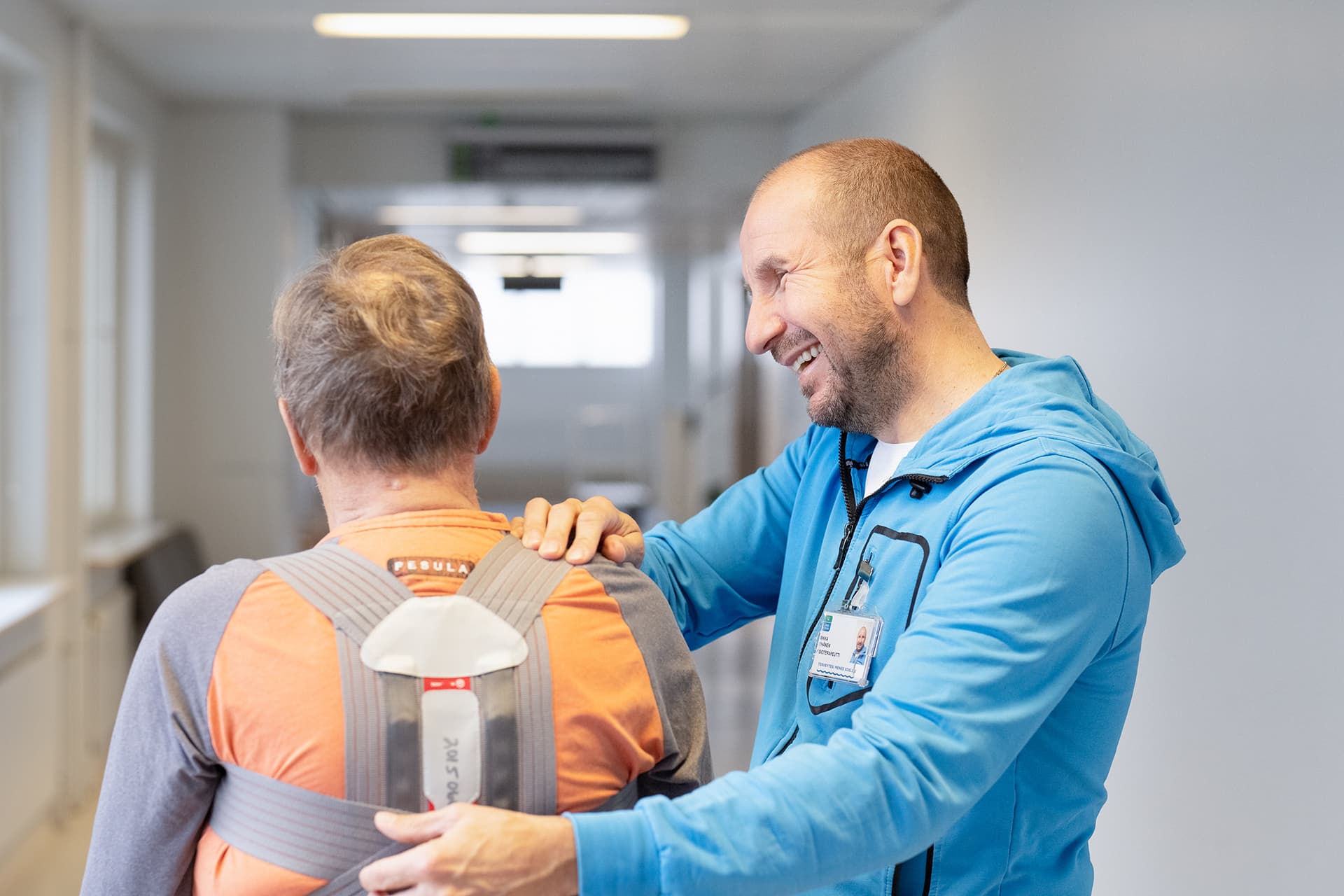
A physiotherapist can design individual exercises to strengthen the muscles and keep the back moving. A support brace can provide temporary help during the painful phase. However, long-term use is not generally recommended, as the trunk muscles should stay active.
In self-care, the most important thing is to find a way to exercise, rest and train so that the symptoms remain manageable. Regular exercise, mobility exercises, stretching and maintaining muscular fitness support the maintenance of functional capacity.
Keep light exercise as part of your daily life. Short walks several times a day suit many better than a single long session. If pain forces you to stop, sit down or lean forward and then continue. When walking goes better, the distance and load can be increased gradually.
Cycling and an exercise bike are often easier than walking, because the back can be slightly rounded. Pool therapy, aqua jogging and swimming reduce the strain.
Nordic walking can extend the walking distance if the poles help in leaning slightly forward.
Change your position often. When sitting, a small pillow behind the lower back and feet on the floor can help.
When sleeping, a pillow placed under or between the knees can relax the back.
For temporary pain, over-the-counter painkillers can be used according to the package instructions. Common options include anti-inflammatory drugs and paracetamol. If necessary, a physician can also prescribe medication intended for nerve pain. Cold or heat can relieve muscle tension and ease symptoms.
If medication is needed daily for a prolonged period, agree on a medication plan with a physician.
These gentle exercises can be suitable for many people who do not have severe symptoms. Perform the exercises calmly and stop if radiating pain, numbness, or weakness increases. The exercises do not replace guidance from a physiotherapist.
1. Seated knee-to-chest lift
Sit on a sturdy chair. Slowly lift one knee towards your chest and lower your leg back down. Do the same with the other leg.
Repetitions: 5–10 times per leg.
2. Pelvic tilt lying on your back
Lie on your back with your knees bent and the soles of your feet on the floor. Gently tilt your pelvis so that your lower back presses gently against the floor. Return to the starting position.
Repetitions: 5–10 times.
3. Gentle seated back rounding
Sit on a chair with your feet firmly on the floor. Slowly round your back and let your upper body tilt slightly forward. Slowly return to an upright position.
Repetitions: 5–10 times.
Once the exercises go smoothly, it is worth making them part of everyday life. A physiotherapist can advise on how to increase the exercises and how to adapt the training to your own functional capacity.
Surgical treatment is considered if the pain is unbearable, walking distance becomes very short, or muscle strength decreases. The decision is made together with a physician based on the symptoms, functional capacity, and magnetic resonance imaging findings. Immediate surgery is rarely necessary.
The operation is usually performed under general anaesthesia utilising microsurgical techniques. During surgery, more space is created for the nerve roots by removing tissue that causes constriction. If the back is unstable, spinal fusion can be combined with the surgery.
Less invasive navigation surgery can also be used. In this procedure, the surgery is precisely guided with the aid of imaging and a navigation system, aiming to spare the surrounding tissues as much as possible.
After surgery, patients usually stay in the hospital for 1–2 days, but some operations can be performed as day surgery. Patients get up and move on the day of surgery. You can usually return home walking, with the support of crutches if necessary. Reaching downwards may feel difficult after surgery. Stitches are usually removed in about two weeks.
The length of sick leave is usually 2–8 weeks. It is affected by the initial situation, job description and recovery. In heavy work, returning to work may take longer. Physiotherapy can be helpful in strengthening supporting muscles and restoring functional capacity.
Our surgery advice service will help you find out whether surgical treatment for spinal stenosis could be suitable for your situation and how you can proceed at Mehiläinen hospital.
Leave your contact information, and we will contact you as soon as possible. Contacting us does not commit you to anything.
Spinal stenosis cannot always be prevented. However, regular exercise, muscular fitness, body care, a normal weight, non-smoking, and healthy food support back health and the maintenance of functional capacity.
If numbness, muscle weakness, pain, or walking difficulties increase, early assessment is important. This allows the cause of the symptoms to be investigated and treatment to be started, if necessary, before a significant decline in functional capacity.
Spinal stenosis itself does not usually disappear, as it is related to wear-and-tear changes in the spine. However, symptoms may ease or remain unchanged without surgery, even if the stenosis persists.
Stenosis usually develops slowly, but symptoms can vary considerably from day to day. Worsening may be reflected, for example, in a shortened walking distance, increasing numbness, or muscle weakness. New or rapidly increasing muscle weakness requires an assessment performed by a physician.
No. Neurogenic claudication can also be caused by circulatory disorders in the lower limbs. In spinal stenosis, symptoms are often relieved by sitting or bending forward, whereas in circulatory-related neurogenic claudication, the pain is usually relieved by stopping.
Lumbar spinal stenosis typically causes pain, numbness or weakness in the lower back, buttocks and lower limbs that worsens when walking. Cervical spinal stenosis, in turn, can cause radiating pain or numbness in the upper limbs, reduced hand dexterity and sometimes walking difficulties.
Severe nerve compression can disrupt urinary bladder and bowel function. Difficulty urinating, urinary retention, or difficulty controlling faeces together with numbness in the perineal or genital area require an immediate assessment to be performed.
No. In spinal disc herniation, the contents of the disc protrude outwards and can press on a nerve root. In spinal stenosis, the space for the nerves is usually reduced by several degenerative changes in the spine, such as thickened ligaments, bone spurs and flattening of the discs.
Severe complications are rare. Possible adverse effects include infection, dural injury, and nerve root injury. Risks associated with surgery are always assessed in relation to symptoms and the benefits of treatment.
It can have an impact if pain, neurogenic claudication, or weakness restricts working for a long time. The work ability assessment is performed by the attending physician. Matters concerning sick leave, rehabilitation, and pensions are clarified with occupational health care, Kela, or the insurance company.