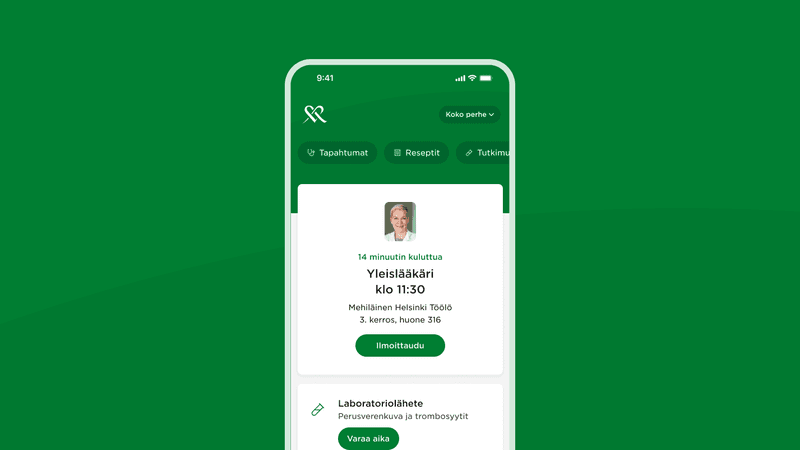
OmaMehiläinen – health services in your pocket
Read moreScoliosis is often asymptomatic, and the first sign is typically a visible change in posture. Asymmetry of the back may be noticed, for example, from different heights of the shoulders or shoulder blades, an asymmetrical waistline, or a tilted torso.
Back pain may occur in some people with scoliosis. Shortness of breath is a rare symptom associated only with very severe forms of scoliosis.

Revised 10/9/2026
Published 10/2/2026
Scoliosis refers to a three-dimensional posture defect of the spine, the most noticeable feature of which is the curvature of the back sideways. Due to the curvature, the back can resemble the letter C or S when viewed from behind. The degree of curvature is assessed from an X-ray.
Scoliosis can be structural, where there is a permanent change in the spine, or functional, where the curvature of the back is caused by, for example, a leg length discrepancy or a pain condition.
A suspected scoliosis or concern about the condition of the back is always a good reason to consult a professional. Particularly for growing children and adolescents, an early assessment plays a key role, as any curvature can worsen rapidly during a growth spurt.
Seek an assessment by an orthopaedist specialised in back problems if:
Mehiläinen’s experienced orthopaedists will determine the cause of the symptoms, make an accurate diagnosis, and create an individual treatment plan with you.
The most common way to detect scoliosis is the forward bend test, which is familiar to many from school health care, for example. In the test, the person bends their upper body relaxed forward while keeping the knees straight. Viewed from behind, scoliosis is often revealed as a one-sided prominence on the back, known as a rib hump. It occurs when the spine rotates as it curves.
The forward bend test is a good initial test, but the final diagnosis is always confirmed at a physician's practice. If necessary, a full-spine X-ray is taken to measure the severity of the scoliosis, which is essential for planning follow-up treatment. The X-ray should always be taken as a so-called long-length image, allowing the entire back to fit into a single image. Separate images of the lumbar and thoracic spine provide no diagnostic benefit.
The goal of scoliosis treatment is to prevent the curvature from worsening, relieve symptoms, and improve quality of life. An orthopaedist specialised in back problems always designs the treatment individually, taking into account the extent of the curvature, your age, and your symptoms. Treatment decisions are always made together with you.
Mild, asymptomatic scoliosis (usually under 20–25 degrees) can be monitored with regular follow-ups, especially once growth has ended. An orthopaedist ensures that the curvature does not worsen.
Physiotherapist-guided exercise is an important part of treatment. Individual exercises strengthen the core muscles, improve posture and manage potential pain.
In growing children and adolescents, brace treatment is an effective way to prevent moderate scoliosis (over 25 degrees) from worsening. Although the treatment requires commitment, at its best it can prevent the need for surgery.
Surgical treatment of scoliosis may be necessary if the curvature is severe or worsens rapidly. Surgery is usually considered when the curvature exceeds 45–50 degrees and other treatments do not help. The goal of surgery is to correct posture of the back, stop the progression of the postural deformity, and improve your quality of life.
In Finland, surgical treatment of scoliosis in growing children and adolescents is centralised in university hospitals. At Mehiläinen, we do not perform scoliosis surgeries, but our experienced spine orthopaedists can refer you, if necessary, for an assessment for surgical treatment.
Mild scoliosis is not dangerous, and you can live a completely normal life with it. As it progresses, very severe and untreated scoliosis can affect lung function. Therefore, an assessment and follow-up by a specialist are important.
Structural scoliosis does not heal on its own, but its progression can be effectively slowed down and symptoms alleviated with the right treatment. Functional scoliosis, which is caused, for example, by a difference in leg length, can on the other hand be corrected when the underlying cause is treated.
Yes, it is possible. Scoliosis diagnosed in childhood can continue to progress slowly, or scoliosis can develop only in adulthood as a result of wear and tear of the spine. Regular follow-up is also important in adulthood if the curvature is significant or causes symptoms.
Yes, and it is even highly recommended. Versatile exercise and especially strengthening the core supporting muscles is an important part of self-care. An orthopaedist and a physiotherapist can provide individual instructions on sports and exercises that are suitable for your specific situation.
In the self-care of scoliosis, regular exercise and strengthening the back muscles are key. Under the guidance of a physiotherapist, you can learn the right exercises that support the spine and relieve symptoms. In addition, avoiding smoking and maintaining a healthy weight promote the overall well-being of the back.
Recovery from scoliosis surgery is an individual process that progresses in stages. In the initial stage, the focus is on pain management and early mobilisation in the hospital. Physiotherapy is usually started already in the hospital and continued after discharge. A full level of activity is typically achieved within about a year of the surgery.
Book an appointment with our orthopaedist specialising in back problems. They are the right specialist to determine the cause of the symptoms and make an accurate diagnosis. At the appointment, you can together prepare an individual treatment plan based precisely on your situation.