Revised 6/26/2026
Published 7/3/2026
Insemination is suitable for many couples suffering from infertility and for single women.
Insemination may be a suitable treatment choice when:
Intracervical Insemination (IUI, Intrauterine Insemination) is an infertility treatment in which the male's sperm are injected with a thin catheter directly into the woman's uterus at the time of ovulation. The aim is to shorten the sperm's journey and increase their chances of meeting the egg, which improves the probability of fertilisation. Insemination is the first procedure in infertility treatment. It is a lighter treatment than in vitro fertilisation.
Preparation for insemination usually begins with infertility examinations to determine the cause of infertility and ensure the suitability of the treatment. Before treatment, a woman's menstrual cycle can be monitored and, if necessary, stimulated with medication to ensure the maturation and release of an egg cell.
In Felicitas Mehiläinen, insemination treatment is a carefully planned and executed process where you are supported at every stage. The treatment usually begins with monitoring the menstrual cycle and possibly with ovarian follicle maturation treatment.
A woman performs an ovulation test. Insemination is usually performed the day after the ovulation test is positive or an ovulation-inducing medication has been administered.
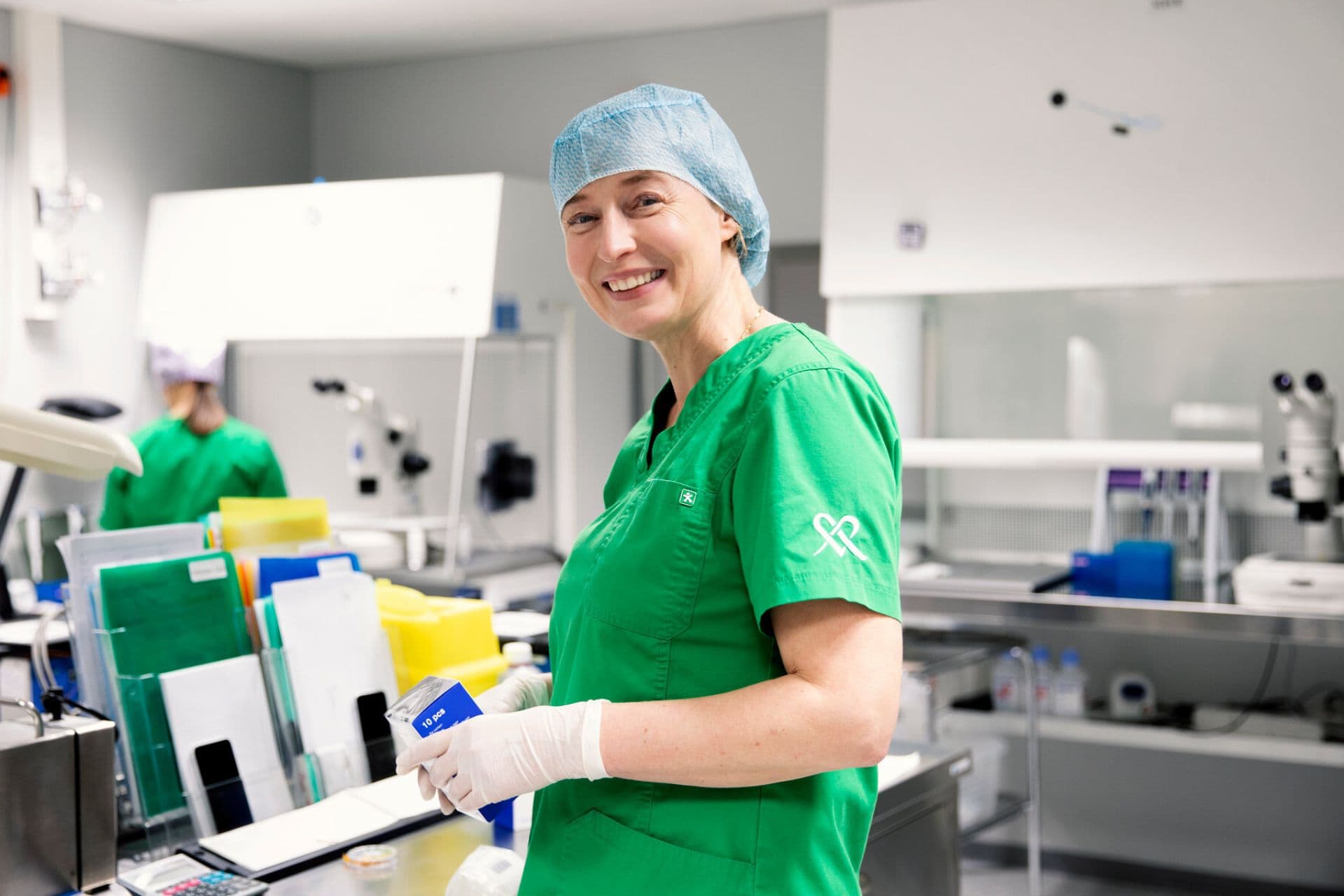
The best and most motile sperm are separated from the man's semen in the laboratory. If donated sperm are used, they are thawed and prepared.
Prepared sperm are injected into the woman's uterine cavity with a thin plastic catheter. The procedure does not take long, and after it, one can live normally.
After about two weeks from the insemination, a pregnancy test is performed.
Approximately 10–20% of inseminations lead to pregnancy. Most pregnancies begin within 3–4 treatment cycles.
After insemination, you can usually return to normal activities immediately. Possible mild lower abdominal pain or spotting may occur, but these are rarely serious. Waiting for the pregnancy test result can be an exciting time, and Felicitas Mehiläinen staff will support you through this phase as well.
If pregnancy does not occur on the first attempt, insemination can usually be tried several times. If you have any questions or concerns after the treatment, contact a nurse or physician.
Insemination with donor sperm is an option when one's own gametes cannot be used, for example, due to lack of sperm, poor quality, or the risk of hereditary diseases. It is also used in treatments for female couples and women hoping for a child alone. At Felicitas Mehiläinen, you can choose sperm from your own or an international sperm bank.
The success rate of insemination varies individually, but it is on average 10–20 percent per treatment cycle. Many factors affect success, such as the woman's age, the cause of infertility, and sperm quality. Several treatments are often needed for pregnancy to occur.
Pregnancy can begin already with the first insemination, but often 3–4 treatments are needed. If pregnancy has not occurred after these treatments, other infertility treatments, such as in vitro fertilisation, can be considered. The treatment plan is always tailored individually.
The price of insemination varies slightly depending on whether the treatment is performed in the public or private sector and whether additional services are needed, such as medication or donated sperm. At Felicitas Mehiläinen, you will receive an exact price estimate during your consultation visit. In the private sector, the price is usually a few hundred euros per treatment cycle.
Insemination is performed by injecting prepared sperm with a thin catheter directly into the woman's uterus. The procedure is usually painless and quick, and it is performed at the time of ovulation. Before insemination, the woman's menstrual cycle is monitored and ovulation is precisely timed.
Assisted reproduction is a general term for infertility treatments in which fertilisation is assisted by medical means. Insemination is a form of assisted reproduction in which sperm are introduced into the uterus. Other forms of assisted reproduction include in vitro fertilisation (IVF) and intracytoplasmic sperm injection (ICSI).
Insemination treatment is suitable for many couples suffering from infertility and for single women. It is a good option especially when the woman's fallopian tubes are open and the man's sperm quality is sufficient. The treatment can also be a solution in situations where intercourse is difficult or impossible.